
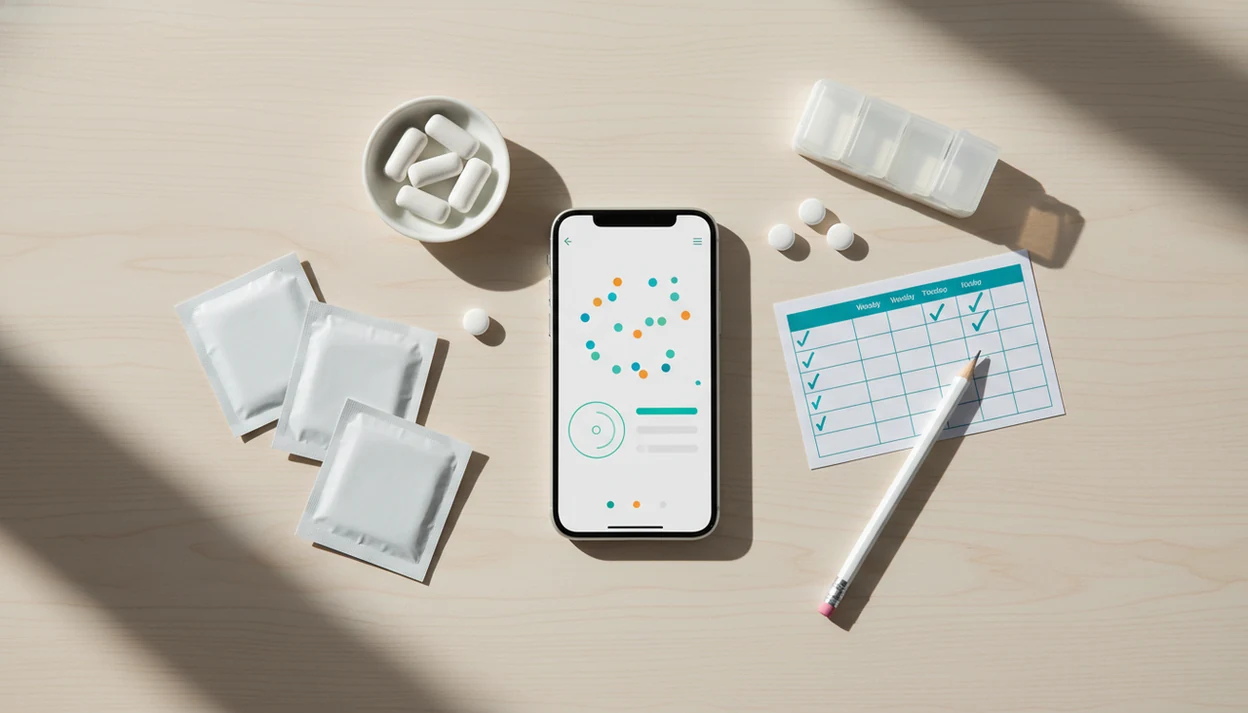
Definition: Nicotine quit methods are evidence-based strategies—including nicotine replacement therapy, prescription medications, behavioral counseling, and app-based tracking—used alone or in combination to help adults stop smoking or vaping.
Seven Evidence-Based Nicotine Quit Methods Compared
Quick answer: For many people, the strongest nicotine quit plan combines a medication or nicotine replacement option with behavioral support and a way to track cravings, triggers, and progress. Apps can help organize the daily behavior side of quitting, but medication questions, pregnancy, major health conditions, or severe withdrawal should be discussed with a clinician.
Key takeaways
- Combination plans often work better than relying on willpower alone.
- Nicotine patches, gum, and lozenges may reduce withdrawal when used as directed.
- Tracking cravings can reveal patterns by time, place, mood, or habit.
- Prescription quit medications require medical guidance and may not fit everyone.
- Slip-ups are common; reviewing the trigger is usually more useful than restarting from zero.
- If withdrawal feels unsafe, intense, or linked to mental health symptoms, get clinical support.
The main ways to quit nicotine are NRT, prescription medication, counseling, behavioral skills, hypnosis, tapering or cold turkey, and app-based tracking. The strongest plans usually combine a medication pathway with a behavior pathway.
| Method | What it does | Effectiveness tier | Trackable in an app? |
|---|---|---|---|
| Patches | Give steady nicotine through the skin | High | Yes, dose and step-down dates |
| Gum or lozenges | Treat sudden cravings by mouth | High | Yes, pieces used and craving time |
| Varenicline or bupropion | Reduce reward, withdrawal, or cravings | High | Yes, adherence and side effects |
| Quitlines | Add structured telephone counseling | High when combined | Yes, call dates and action steps |
| CBT or ACT tools | Change cue-craving-response loops | Moderate to high | Yes, triggers and coping plans |
| Hypnosis | Uses suggestion and relaxation | Mixed | Yes, session dates and urges |
| Cold turkey or tapering | Stops suddenly or reduces gradually | Low to moderate | Yes, daily limits and slips |
| App tracking and coaching | Keeps the quit plan visible | Supportive | Yes, core function |
For a person who smokes heavily, quit smoking with nicotine patches plus a short-acting option is often easier than cold turkey because withdrawal is less abrupt.
How Nicotine Cessation Methods Work Behind the Scenes
Nicotine cessation methods work by weakening both the body’s nicotine drive and the habit loop around smoking or vaping. Clinicians typically recommend combining medication or NRT with counseling because it targets withdrawal and behavior at the same time.
- NRT and medications affect receptors: Patches, gum, lozenges, varenicline, and bupropion reduce nicotine withdrawal by changing how the brain responds to nicotine signals.
- Cue-craving loops can fade: If the after-dinner chair facing the open window no longer leads to a cigarette, the cue loses force over time.
- ACT builds psychological flexibility: Urge surfing teaches you to notice a craving without obeying it.
- App use reinforces new loops: Opening a tracker during a three-minute craving creates a repeatable pause between urge and action.
- Combination care performs better: The U.S. Surgeon General reports that counseling plus medication can more than double quitting success compared with minimal support.
Small pauses count.
The most common medically supported way to quit smoking is FDA-approved cessation medication combined with behavioral support.
How to Choose and Track Your Nicotine Quit Method
Choose a nicotine quit method by matching support level to dependence, then track whether the plan works in real life. A heavy daily smoker usually needs more structure than someone who only vapes during weekend drinks.
- Assess your dependence level: Count cigarettes per day, vape sessions, first nicotine use after waking, and high-risk times.
- Pick a primary method: Choose NRT, prescription medication, or a behavioral-only approach based on dependence and medical fit.
- Add a complementary tool: Pair the primary method with app tracking, a quitline, or counseling.
- Log your quit date: Add baseline cravings, triggers, and daily limits in MeQuit before the quit date arrives.
- Review weekly data: Look for patterns, then adjust dose timing, coping tools, or trigger plans.
The thumb hovering over a reset button is familiar after a slip. Reset, not restart from zero. If you prefer a slower route, a gradual reduction smoking plan can make the first week feel less like a cliff.
Nicotine Patches, Gum, and Lozenges as Trackable NRT Options
Nicotine replacement therapy gives controlled nicotine without tobacco smoke or vape aerosol. Patches are steady background support, while gum and lozenges are useful when a craving spikes.
- Patches deliver steady nicotine: They work well for people who wake up wanting nicotine before anything else.
- Gum and lozenges are short acting: They fit sudden craving windows, like the break after a tense meeting.
- Combination NRT is common: A patch plus gum or a lozenge can cover both baseline withdrawal and acute urges.
- FDA-approved cessation medications help: According to a Cochrane review, NRT, bupropion, and varenicline increase quit rates by 50–60% compared with unaided quitting the NIH.
- Side effects are trackable: Log skin irritation from patches, jaw soreness from gum, or throat irritation from lozenges.
People comparing forms often start with quit smoking with nicotine gum when cravings are sharp but not constant.
Ready to start your quit?
The most effective nicotine quit methods combine FDA-approved tools like patches, gum, or prescription medications with behavioral support and app-based tracking that logs…
Prescription Medications for Quitting Nicotine
Prescription medications for quitting nicotine can be effective, but they require medical guidance. Apps can support adherence and symptom notes, not decide whether a medication is safe for you.
- Varenicline blocks nicotine reward: It partially activates nicotine receptors while reducing the payoff from smoking.
- Bupropion reduces cravings: It can ease withdrawal symptoms for some adults.
- A clinician should screen first: Pregnancy, seizure history, mental health symptoms, drug interactions, and other conditions matter.
- Daily logging helps: Record doses taken, missed doses, sleep changes, mood shifts, and cravings.
- Evidence supports medication: Cochrane evidence finds FDA-approved cessation medications improve quit rates compared with unaided quitting.
A notes field matters here. “Felt wired at 10 p.m.” is more useful than trying to remember the week later.
Behavioral and CBT-Style Quit Smoking Methods
Behavioral quit smoking methods teach you what to do before, during, and after a craving. They work on the trigger pattern, not just the nicotine level.
- ACT apps have trial evidence: In a randomized trial, the ACT-based iCanQuit app produced 12-month quit rates of 28.2% versus 21.1% for QuitGuide, about 1.5 times higher odds of quitting. jamanetwork.
- CBT names the loop: Trigger, thought, feeling, urge, action, and result become visible.
- Quitlines add free coaching: A quitline and app to stop smoking can combine human support with daily tracking.
- Hypnosis has mixed evidence: Some people find it calming, but results are less consistent than NRT or counseling.
- Craving logs can mirror thought records: Tools like Me Quit let users record the cue, urge strength, coping action, and outcome.
For anxious or routine-driven smokers, CBT for quitting smoking usually works best when the trigger list is specific.
Why a Stop Nicotine App Increases Long-Term Quit Rates
A stop nicotine app can improve quitting by keeping the plan active during ordinary trigger moments. It is not magic, but it can turn scattered efforts into a visible day-by-day support system.
- Behavioral app design matters: The iCanQuit trial found higher 12-month quit rates than a standard informational app.
- Engagement predicts usefulness: Someone who logs for 26 weeks gives the app more data than someone who disappears after four days.
- Cross-habit tracking fills a gap: Friday 6 p.m. drinks can make a cigarette feel automatic.
- Patterns become harder to ignore: “I smoke more when I drink” is a plan-changing observation.
- Demand is high: Per the CDC, about 68% of U.S. adults who smoke want to quit, and about 55% tried in the past year. CDC smoking data.
A well-designed stop nicotine app should deliver private progress tracking and reset prompts, not a diagnosis or a guaranteed cure.
When to Talk to a Clinician About Quitting Nicotine
Talk to a clinician when your quit plan involves prescription medication, complex health history, or symptoms that feel unsafe. Apps can help you track what is happening, but they cannot diagnose, prescribe, or clear a medication for you.
A medical check is especially important before varenicline, bupropion, or combining multiple medication supports. Pregnancy, seizure history, heart conditions, current mental health symptoms, and possible drug interactions can all change what is safest. If quitting brings severe mood changes, thoughts of self-harm, panic that feels unmanageable, chest pain, or any immediate safety concern, seek urgent help instead of waiting for the next app reminder.
- List your current nicotine use: Bring cigarettes per day, vape frequency, first-use timing, and past quit attempts.
- Share your health context: Mention pregnancy, seizures, heart history, mental health symptoms, and all medications or supplements.
- Ask about medication fit: Confirm whether NRT, varenicline, bupropion, or combinations make sense for you.
- Use your logs as evidence: Show cravings, sleep changes, mood notes, and side effects.
- Add human support: If repeated unsupported attempts keep collapsing, use a quitline or clinician-guided plan.
Limitations
No nicotine quit method offers a 100% success rate. Relapse is common, and many people need several combinations before one sticks long enough to become normal.
- Cold turkey is common, but unassisted success rates are usually lower than supported quit attempts.
- Prescription medications can have contraindications, so clinician guidance matters.
- Alcohol, stress, and social routines can keep nicotine cues alive even after withdrawal fades.
The pocket check is real. A mint pod wrapper in a backpack can still trigger a craving weeks later.