The Truth About Alcohol and Creativity
Alcohol does not reliably make you more creative; the best evidence suggests it may loosen thinking on narrow insight tasks while impairing the memory, focus, judgment, sleep, and follow-through that real creative work needs. If you are asking “does alcohol make you creative,” the honest answer is: it may change how creative you feel, but it is not a dependable creativity strategy.
> Definition: Alcohol and creativity refers to the short-term and long-term effects of drinking on idea generation, inhibition, attention, memory, judgment, sleep, and creative execution.
TL;DR
- Low-dose alcohol may help some people solve narrow insight puzzles, but it does not improve all forms of creativity.
- Alcohol can quiet self-criticism by reducing executive control, yet that same effect can harm editing, planning, memory, and follow-through.
- For people trying to drink less, linking alcohol with creativity can become a powerful psychological cue that makes change harder.
Alcohol and creativity: the short answer for real creative work
Quick answer: Alcohol does not reliably make people more creative. It may make ideas feel easier or less inhibited, but it often weakens attention, memory, judgment, sleep quality, and the follow-through needed to turn ideas into finished work.
Key takeaways
- A relaxed feeling is not the same as better creative output.
- Alcohol may help some people stop overthinking, but it can also reduce accuracy and self-editing.
- Next-day creativity often depends on sleep, recall, mood, and sustained focus.
- If drinking becomes part of your creative ritual, cravings and cue-based habits can grow stronger.
- Testing sober creative sessions can help separate the art from the alcohol cue.
- If you drink heavily or may have withdrawal symptoms, talk with a clinician before cutting down abruptly.
Does alcohol make creative work better? Usually, no. Alcohol can create a temporary feeling of looseness, warmth, or “finally, my ideas are moving,” but that feeling is not the same as producing stronger work.
Creative work has phases. The first phase is messy idea generation, when unusual connections can help. Later phases need a different brain state: shaping, testing, editing, remembering details, taking feedback, and finishing. Alcohol may reduce the pressure of the blank page, but it can also make the next decision point worse.
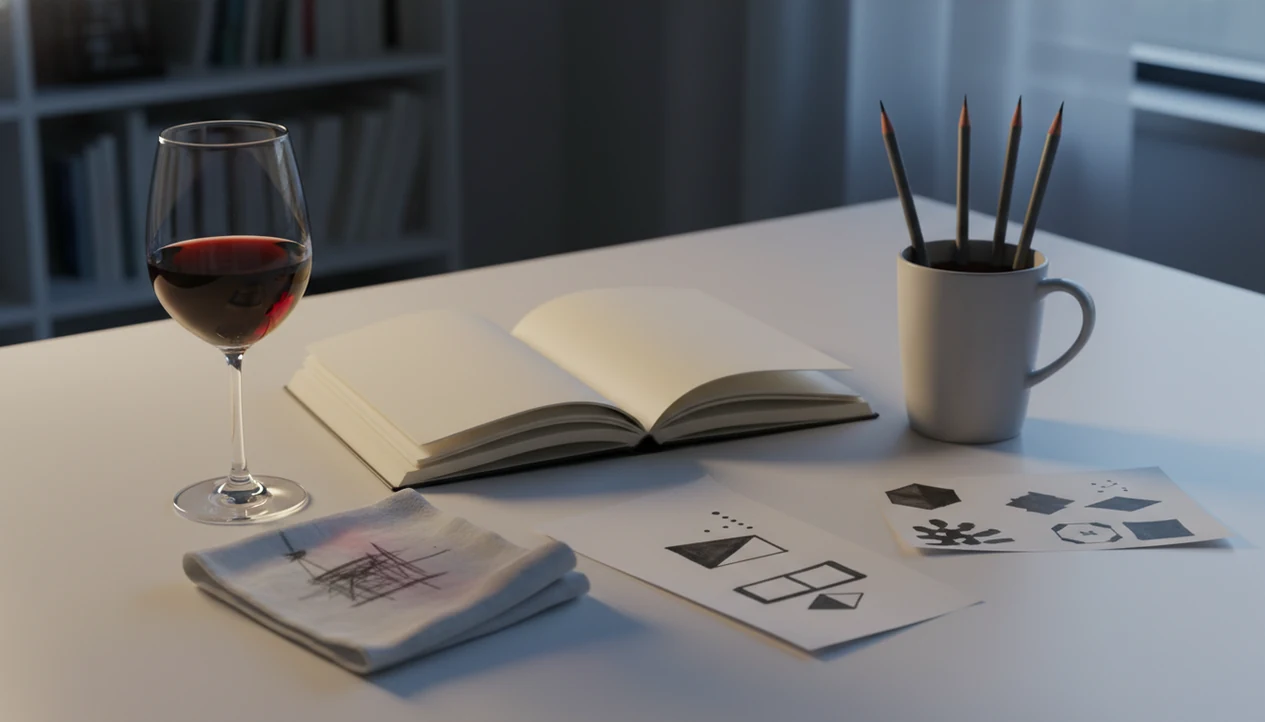
The napkin idea may glow at midnight.
By morning, it often needs repair. For adults trying to drink less, the practical question is not whether one drink ever changes thinking. It is whether the ritual becomes a cue. Me Quit looks at that cue without shame: what did the drink promise, what did it cost, and what replacement action makes the next session easier?
How alcohol and creativity works
Alcohol and creativity works by changing the balance between looseness and control. In the short term, alcohol can lower inhibition and soften executive control, the brain’s “manager” for focus, planning, error-checking, and stopping impulses.
That shift can make ideas feel easier to say out loud. The problem is that creative work is not one single act. Idea generation may benefit from a little less self-censorship, but evaluation needs sharper judgment. Memory has to preserve the useful detail. Follow-through has to turn the spark into a draft, mix, design, or decision that still works later. Alcohol can make the first phase feel warmer while quietly weakening the later phases that decide whether the work is any good.
A simple way to separate the phases is:
- Generate rough ideas without judging them too early.
- Capture them clearly enough that sober-you can understand them.
- Delay evaluation until the emotional high has passed.
- Review after sleep, because alcohol-disrupted sleep can reduce next-day memory, mood stability, and flexible thinking.
- Finish with sober attention, feedback, and revision.
That is why feeling creative can diverge from producing stronger work.
Five facts about alcohol and creative thinking
- In one placebo-controlled lab study of 70 adults, mild intoxication around 0.03 blood alcohol concentration improved performance on the Remote Associates Test, an insight task involving remote word connections the NIH.
- The same low-dose alcohol condition did not improve divergent thinking, which means it did not help people generate more varied uses or possibilities.
- Alcohol impairs executive control, so associations may feel looser while self-monitoring, working memory, and planning get weaker.
- People may overestimate their creativity when they expect alcohol to help, especially if the ritual already feels tied to identity.
- Heavy or regular drinking can undermine sleep, mood, brain health, and sustained creative productivity over time.
A measuring shot glass near the sink can become more than a drink tool. It can become the opening bell for “creative mode.” That cue matters. For people changing alcohol patterns, the trigger map is part of the work.
Prefrontal cortex effects of alcohol on creative work
Alcohol affects creative work partly by reducing prefrontal cortex control, which can lower inhibition but also weaken the mental skills needed to finish complex ideas.
Executive control is the brain’s project manager. It helps you focus, hold an idea in working memory, stop unhelpful impulses, notice errors, and solve problems. When alcohol reduces that control, thoughts may feel less filtered. Your inner critic gets quieter. A strange connection may seem easier to say out loud.
That can feel freeing.
However, complex creative work needs both looseness and control. A songwriter still has to choose the stronger line. A designer still has to test the layout. A founder still has to notice where the plan breaks. NIAAA notes that long-term heavy drinking can affect brain structure and function, including areas involved in planning, impulse control, and decision-making NIAAA alcohol data, which are directly relevant to creative follow-through. The broader decision-making piece is covered in alcohol affects decision making.
Wine and creative thinking: insight tasks versus divergent ideas
Wine is still alcohol, and the research nuance matters. Insight tasks and divergent thinking are not the same thing, so a small effect in one lab task should not be treated as proof that drinking improves creative work.
| Creative task type | What it means | What low-dose alcohol showed | Real-world caution |
|---|---|---|---|
| Insight tasks | A remote connection suddenly clicks, like solving a word puzzle | The 2017 study found better Remote Associates Test performance at low BAC | A word puzzle is not a chapter, pitch deck, painting, or album |
| Divergent thinking | Generating many possible uses, angles, or directions | The same study found no improvement | Many creative projects need quantity before quality |
| Creative execution | Selecting, editing, testing, and finishing | Alcohol generally works against focus and judgment | The draft still has to survive sober review |
For writing, music, design, and entrepreneurship, the useful question is simple: did the idea hold up later? For most people, sober review is where the real signal appears.
Before you test creativity without alcohol
Do not drink intentionally to run a creativity experiment. The safer question is whether a sober, repeatable cue can help you create without making alcohol part of the ritual.
Before you self-test, pause if drinking is already hard to control. Get clinician support first if you have shaking, sweating, nausea, panic, insomnia, seizures, blackouts, pregnancy, liver disease, medication interactions, past alcohol use disorder, or urges that feel unsafe. Withdrawal can be medical, not just motivational.
- Pick one task you can repeat without changing the rules, such as 500 rough words, ten thumbnail sketches, three chorus ideas, or one product concept page.
- Choose one sober cue that can sit where the drink used to sit, like tea, sparkling water, gum, a candle, a timer, or the same opening playlist.
- Keep conditions steady by using a similar time of day, session length, and workspace so you are not measuring chaos.
- Track both output and urges with simple notes: minutes focused, ideas made, pieces kept, cravings, restlessness, or “I need a drink” thoughts.
- Wait at least two weeks before judging the pattern, because one good or bad session is not enough signal.
Six-step creativity test without alcohol dependence cues
A sober creativity test works by replacing the alcohol cue with a repeatable experiment, then measuring output instead of mood. Use it for two weeks before deciding what helps.
Do not use this as a reason to drink on purpose or compare intoxicated sessions against sober ones. The safer test is whether a repeatable non-alcohol cue can produce work that still looks useful after sleep.
- Choose one creative task you can repeat, such as drafting 500 words, sketching thumbnails, or writing chorus options.
- Run a sober idea session at the same time of day, with water, gum, or a timer where the drink usually sits.
- Track the output with simple numbers: ideas made, minutes focused, lines kept, or versions completed.
- Review ideas later after sleep or a walk, not during the first emotional high.
- Log cravings or drinking urges if the session triggers “I need something” thoughts, tight chest, or restless legs.
- Repeat under consistent conditions before comparing sober sessions with alcohol-linked sessions.
Me Quit can help adults track cravings, streaks, milestones, and mindful alcohol reduction alongside creative routines. A good Me Quit mequit addiction recovery hub for quit smoking, stop vaping, quit drinking, and mindful alcohol reduction workflow should support private cue tracking and streak repair, not promise that an app can replace medical care.
Alcohol REM sleep costs for next-day creativity
Creativity depends on more than the moment you get an idea. It also uses memory consolidation, emotional regulation, and next-day mental flexibility, all of which are tied to sleep quality.
MedlinePlus states that alcohol can reduce REM sleep in the first half of the night and increase sleep fragmentation in the second half medlineplus. That matters because REM sleep helps the brain connect memories and emotional material. If you drink late, the idea may feel electric at 11:40 p.m., then look thin after a broken night.
The notebook is not lying. Your state changed.
Try a lower-friction replacement: write the rough idea, leave the room, sleep, walk in the morning, then review. Incubation time often protects the useful spark without making alcohol the gatekeeper. For more on the sleep side, the alcohol deep sleep guide explains why brain fog can show up after evening drinking.
Alcohol and creativity myths that keep people drinking
Some creativity myths are sticky because they mix truth, romance, and ritual. The risk is psychological dependence: “I need alcohol to create.” That belief can become a stronger cue than the drink itself.
- The tortured genius myth: Famous artists are not creative because they drink. Talent, taste, practice, revision, and timing are separate from intoxication.
- The first-drink unlock myth: Alcohol may reduce self-censorship, but it can also weaken the judgment needed to choose what is worth keeping.
- The ritual identity myth: A rocks glass, playlist, or bar stool can start to feel like part of the creative self.
- The harmless helper myth: NIAAA estimates that 28.9 million U.S. adults had alcohol use disorder in 2023 NIAAA alcohol data, so promoting drinking as a creativity tool has real risk.
For many adults, the safer move is to treat drinking thoughts as cues, then practice a replacement action. The pattern overlaps with alcohol craving triggers.
Sober creativity tools for alcohol-free idea generation
Sober creativity tools aim to copy the useful part of reduced self-censorship without alcohol’s costs to memory, sleep, and follow-through. Generate first. Evaluate later.
- Timed freewriting: Set a 10-minute timer and write badly on purpose. The rule is motion, not quality.
- Constraint prompts: Limit the format, color palette, chord progression, or headline structure so the brain has a smaller playground.
- Mind maps: Put the central idea in the middle, then branch associations without ranking them.
- Morning pages and walks: Use first-light writing or a slow walk to let loose connections surface before the day gets loud.
- Voice memos and delayed editing: Capture the spark fast, then judge it hours later.
For many creators, separating generation from evaluation is easier than trying to feel inspired on command because each phase asks for a different mental state.
MeQuit is a quit smoking app that helps adults stop smoking, stop vaping, drink less, and track cravings, streaks, and milestones. If alcohol is one of several linked cues, broader alcohol reduction guides can help you build a practical trigger map.
Limitations
This topic has real caveats. The evidence does not support a simple “alcohol helps creativity” or “alcohol ruins every idea” answer.
- Lab studies often use small samples, simple word puzzles, controlled doses, and short testing windows.
- Individual differences matter, including tolerance, body size, sex, medications, mental health, sleep debt, and drinking history.
- People with withdrawal symptoms, pregnancy, liver disease, medication interactions, or a history of alcohol use disorder should get clinician guidance rather than self-experimenting.
Clinicians typically recommend avoiding alcohol as a coping tool when it worsens health, safety, medication risk, or behavior control.
FAQ
Does alcohol make you creative?
Alcohol may briefly loosen thinking and reduce self-criticism, but it does not reliably improve overall creativity. It can also impair memory, judgment, sleep, and follow-through.
Does wine help creative thinking?
Wine is alcohol, so any creativity effect is dose-specific, limited, and unreliable. A small lab finding on insight puzzles does not prove wine helps writing, art, music, or design.
Why do artists drink?
Artists may drink because of stress, social settings, cultural rituals, habit, or identity cues. Drinking is not the source of creative ability.
Does alcohol quiet your inner critic?
Alcohol can reduce inhibition, which may make ideas feel easier to express. The same effect can weaken judgment, editing, and planning.
Does alcohol improve writing?
Alcohol may make drafting feel easier for some people, especially at the start. It often harms clarity, memory, revision quality, and consistency.
Does alcohol hurt REM sleep?
Yes, alcohol can disrupt sleep architecture, reduce REM sleep earlier in the night, and fragment sleep later. Poor sleep can hurt next-day memory and flexible thinking.
Are sober people less creative?
No, sober people are not less creative by default. Creativity depends on skills, practice, rest, curiosity, feedback, and iteration, not alcohol.
How do I create without drinking?
Use timed drafts, prompts, walks, voice memos, delayed editing, and a clear generate-first, evaluate-later structure. If cravings show up, track the cue and use a replacement action before returning to the task.