Does Alcohol Really Make You More Creative?
Alcohol does not reliably make you more creative overall; alcohol transient hypofrontality creativity describes a temporary lowering of prefrontal-cortex control that can make ideas feel freer, but the research shows only small, task-specific effects. Low-dose alcohol may help some quick insight puzzles, while it can weaken focus, verbal fluency, memory, and sustained creative work.
This article is educational and is not medical advice. If alcohol use is causing withdrawal symptoms, blackouts, anxiety, or an inability to cut back, speak with a licensed clinician or local addiction-support service.
> Definition: Alcohol transient hypofrontality is the short-term reduction in prefrontal-cortex control after drinking, which can lower inhibition and self-criticism without reliably improving creative quality.
TL;DR
- Low-dose alcohol may slightly improve some convergent insight tasks, but it does not broadly boost creativity.
- Drinking lowers prefrontal cortex control, which can feel like freedom while also impairing judgment, focus, and memory.
- For people cutting back, safer creativity supports include sleep, movement, mindfulness, practice, and craving tracking.
Alcohol transient hypofrontality creativity in one sentence
Quick answer: Alcohol may make ideas feel looser by temporarily reducing prefrontal-cortex control, but that is not the same as reliably improving creativity. For many people, any small gain in free association is offset by weaker attention, memory, judgment, and follow-through.
Key takeaways
- A drink may reduce self-criticism, but it can also reduce quality control.
- Low-dose alcohol effects appear most relevant to brief insight tasks, not sustained creative work.
- Memory and focus often suffer even when ideas feel more interesting.
- Feeling original while drinking is not proof that the idea will hold up sober.
- If alcohol is becoming part of your creative routine, tracking urges and triggers can help you spot patterns.
- Heavy daily drinking or withdrawal symptoms should be discussed with a clinician before cutting down.
Alcohol transient hypofrontality creativity means alcohol temporarily reduces prefrontal-cortex control, which may loosen inhibition but does not reliably improve creative output. The prefrontal cortex helps with planning, judgment, self-control, focus, impulse control, and checking whether an idea actually works.
That “inner editor went quiet” feeling can be real. A person may talk more freely, write faster, or toss out stranger ideas after a drink. But lower filtering is not the same as better thinking. It can also mean weaker error-checking, less follow-through, and more confidence than the idea deserves.
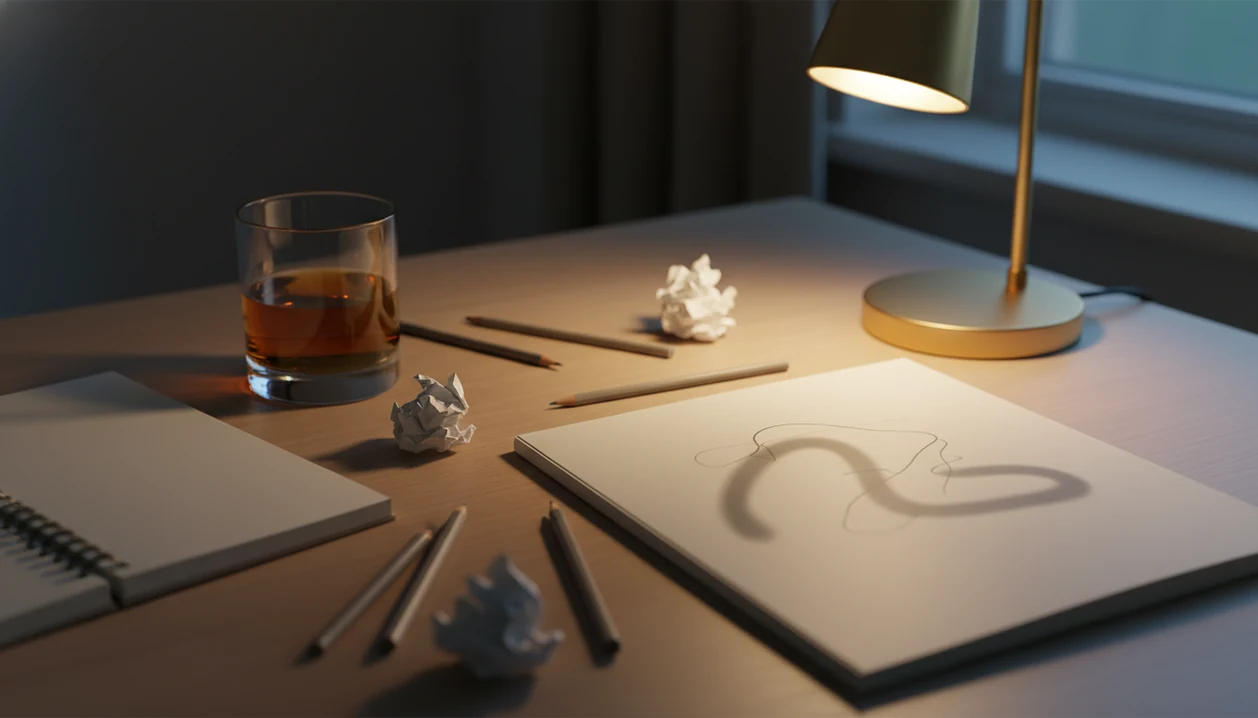
The notebook may look brilliant at midnight. Morning is the test.
For creativity, the useful distinction is simple: alcohol may change how ideas feel while making it harder to refine, remember, and execute them.
Alcohol creativity answer at a glance
Alcohol can make ideas feel more creative because it quiets self-monitoring. That can reduce the “no, that’s stupid” voice long enough for unusual associations to surface. For someone stuck on a headline, sketch, or melody fragment, that looseness may feel like a breakthrough.
The practical answer is more cautious. Feeling creative is not the same as producing objectively better ideas. Controlled studies show a small possible benefit for certain quick insight tasks, but broader cognitive tradeoffs show up fast: weaker executive control, poorer fluency, hazier memory, and less careful selection.
For most people, alcohol is a risky creativity shortcut because it lowers the same control system needed to choose, revise, and finish good work.
Five facts about alcohol and creative thinking
- In a 2017 “Creativity on tap?” study, participants at about 0.03 blood alcohol concentration solved more Remote Associates Test insight problems than a placebo group the NIH.
- The same 2017 study found impaired executive control and no improvement in divergent thinking, which is the skill used to generate many possible ideas.
- A 2020 follow-up found that alcohol at 0.03 and 0.06 BAC impaired verbal fluency and showed no creative-thinking benefit on the tested tasks apa.
- More alcohol does not mean more creativity. Higher or repeated drinking can interfere with memory, sleep, attention, and long-term creative productivity.
- The perceived boost often reflects lower self-criticism and higher confidence, not a dependable rise in originality or quality.
The “one drink helped me think” story usually leaves out the next decision point: whether you can still capture, evaluate, and finish the idea.
How alcohol lowers prefrontal cortex control
The prefrontal cortex acts like a control desk. It helps you plan, inhibit impulses, judge risk, hold attention, monitor errors, and decide whether a first idea needs work. In habit-loop language, it helps pause between cue, routine, and reward.
Alcohol can temporarily reduce that top-down control. NIAAA’s overview of alcohol and the brain describes alcohol’s effects on brain systems involved in judgment, coordination, memory, and decision-making NIAAA alcohol data. Speech may feel less filtered. Associations may feel looser. A sentence you would normally delete may stay on the page. That can be useful for noticing a stuck pattern, but it also raises the chance of risk-taking, overconfidence, and weaker error-checking.
This is how alcohol lowers prefrontal cortex control: it turns down the brain’s editor and planner at the same time. The looseness is not free. If drinking also leaves you tired the next day, the creative cost can continue; the sleep side is covered in Why Alcohol Can Leave You Tired.
What alcohol creativity studies actually found
Controlled alcohol creativity studies are narrow, not proof that drinking improves real creative work. They mainly compare short lab tasks after low-dose alcohol, placebo, or no alcohol.
| Study | Alcohol level | What improved | What did not improve | Main caution |
|---|---|---|---|---|
| “Creativity on tap?” 2017 | About 0.03 BAC | Remote Associates Test insight performance | Divergent thinking fluency or originality | Executive control was impaired |
| “Creativity on tap 2” 2020 | 0.03 and 0.06 BAC | No clear creative-thinking benefit | Verbal fluency was impaired | Results did not replicate a broad benefit |
Convergent insight tasks
Convergent thinking means finding one fitting answer, like connecting three distant words with a fourth word. Alcohol may help some people stop over-controlling that search.
Divergent brainstorming tasks
Divergent thinking means producing many varied ideas. The evidence does not show reliable gains here, which matters for writing, design, strategy, and music.
Small lab wins are not the same as a finished draft.
Why drunk ideas often feel more original
Why do drunk ideas feel more original? Lower self-monitoring can quiet the inner critic, so rough thoughts arrive with less resistance. Confidence rises, novelty feels louder, and loosened associations can make a half-formed idea seem profound.
There is also a memory problem. If you do not fully hold the idea in working memory, you may remember the excitement more than the details. The party cooler packed with cans can become part of the ritual: drink, loosen up, chase the “good idea” feeling, then wake up with fragments.
Idea generation and idea selection are different jobs. Generation benefits from looseness, play, and permission. Selection usually needs sober executive function, because editing asks, “Does this actually solve the problem?” For creative work, selection is often where quality appears.
Safer creativity routines without alcohol
Safer creativity routines reduce rumination without adding alcohol’s memory and judgment costs. Try them as small experiments, not personality tests.
- Sleep: Protect the boring foundation. Tired brains often confuse urgency with insight.
- Exercise or walking: Move for 10 minutes, then write the next three ideas before checking your phone.
- Mindfulness: Sit with the tight chest or “I need something” feeling for one minute, then name the cue.
- Freewriting: Set a timer and write badly on purpose. No editing until the timer ends.
- Constraints and practice: Limit the format, color, chord, word count, or first line so the brain has a useful box.
If you are cutting back, Me Quit can support private tracking for cravings, streaks, milestones, and drink goals, but it should not be treated as a cure for cravings or a substitute for clinical care.
For people reducing alcohol, an if-then plan is often easier than relying on mood because it makes the next choice visible before the craving peaks. The broader habit side is covered in our alcohol reduction guides.
What alcohol creativity claims do not cover
Alcohol creativity claims do not prove that drinking improves real-world art, writing, music, strategy, invention, or long-term innovation. Lab tasks are short. Creative careers are not. They require sleep, memory, revision, relationships, deadlines, and repeated practice.
The evidence also does not support heavy drinking as a creative enhancer. According to NIAAA, alcohol use disorder is common enough that relying on alcohol for mood, confidence, or creative effects should be treated as a meaningful risk. The World Health Organization reports that alcohol contributes to over 3 million deaths per year globally, accounting for 5.3% of all deaths the World Health Organization.
Addiction risk matters when alcohol becomes the routine for starting work, calming doubt, or feeling socially brave. Restless hands searching coat pockets, then reaching for a drink, can become one linked trigger map. If tolerance is changing, why alcohol tolerance increases explains the brain adaptation in plain terms.
Limitations
The alcohol-and-creativity evidence has real limits, and those limits matter if you are using the research to make choices.
- The evidence comes from a small number of controlled lab studies.
- Effects appear modest, inconsistent, and task-specific.
- Remote Associates Test performance may not translate to painting, writing, composing, coding, or strategic problem-solving.
If your drinking is tied to anxiety, withdrawal symptoms, blackouts, or feeling unable to stop, get medical or behavioral-health support. An app can track patterns, but it cannot replace clinical care. For app comparisons focused on limits and self-monitoring, the best drink less app guide may help.
When to seek professional help
Seek professional help if alcohol is causing withdrawal symptoms, blackouts, unsafe choices, or a repeated sense that you cannot cut back even when you mean to. Tracking tools can show patterns, but they cannot diagnose or treat alcohol use disorder.
A practical next step is to treat the warning signs as information, not a character verdict:
- Notice red flags such as shaking, sweating, nausea, panic, insomnia, memory gaps, drinking to avoid feeling sick, or failed attempts to reduce.
- Seek urgent care right away for severe withdrawal, confusion, seizures, chest pain, thoughts of self-harm, violence risk, or any situation where you may not be safe.
- Contact a licensed clinician, addiction counselor, crisis line, or local support service for an assessment and a safer plan.
- Mention medications, sleep aids, opioids, anxiety symptoms, depression, trauma symptoms, or mood changes, because mixing alcohol with these can raise medical and safety risks.
- Use apps, notes, or drink logs as supporting details for that conversation, not as a substitute for care.
Getting help early can make cutting back safer and less lonely.
FAQ
Does alcohol help creativity?
Alcohol may help limited insight tasks at low doses, but it does not broadly improve creativity. It can also impair executive control, verbal fluency, memory, and follow-through.
What is transient hypofrontality?
Transient hypofrontality means a temporary reduction in prefrontal-cortex activity or control. With alcohol, that can lower inhibition, judgment, planning, and self-monitoring.
Does alcohol lower inhibition?
Yes, alcohol can lower inhibition by weakening executive control. That may make speech and ideas feel less filtered, but it can also reduce error-checking.
Does alcohol improve brainstorming?
Studies do not show reliable improvement in divergent thinking, which is the skill used for brainstorming many original ideas. Alcohol may make brainstorming feel easier without improving idea quality.
Why do drunk ideas seem better?
Drunk ideas can seem better because alcohol lowers self-criticism, raises confidence, and weakens error-checking. The emotional “aha” feeling can be stronger than the actual idea.
Is one drink good for ideas?
One drink may produce small, task-specific effects for some insight problems, but the tradeoffs are meaningful. It is not a recommended creativity tool.
Does heavy drinking boost creativity?
Heavy drinking is not supported as a creativity aid. It can harm cognition, sleep, memory, health, and long-term productivity.
How can I create without drinking?
Use sleep, movement, mindfulness, freewriting, constraints, practice, and craving tracking. Apps such as Me Quit can help track drink goals and cravings privately while you build alcohol-free routines.