
App To Help Me Stop Smoking With Cravings And Triggers

A stop smoking help app should turn cravings, triggers, streaks, reminders, and milestones into a practical quit plan you can use today. The goal is not to rely on willpower alone, but to open the app when an urge hits, log what triggered it, use a coping tool, and keep moving after slips.
> A quit smoking app helps adults track cravings, triggers, streaks, reminders, and milestones while they build a repeatable quit plan.
- A strong quit smoking app should combine craving help, trigger tracking, reminders, milestones, and relapse recovery.
- Apps work best when used alongside evidence-based support such as counseling, quitlines, nicotine replacement therapy, or FDA-approved cessation medications when appropriate.
- Some apps also support related routines such as vaping or alcohol tracking, which can matter when habits overlap.
How these apps look
Quick answer: An app can help you stop smoking by making urges more visible and easier to act on in the moment. For many people, the most useful apps combine craving logging, trigger patterns, reminders, coping prompts, and progress milestones rather than relying on motivation alone.
Key takeaways
- Use the app during the craving, not only after the day is over.
- Track the trigger, mood, place, and time so patterns become easier to spot.
- Plan short coping actions before high-risk moments like mornings, driving, breaks, or stress.
- Treat a slip as data, then restart quickly instead of abandoning the quit attempt.
- If withdrawal feels intense, ask a clinician about nicotine replacement or prescription options.
- Privacy matters if you are logging sensitive smoking, vaping, drinking, or mood patterns.
Side-by-side captures of the compared products. Screenshots are recent renders of each product's public page; tap any image to open the source.
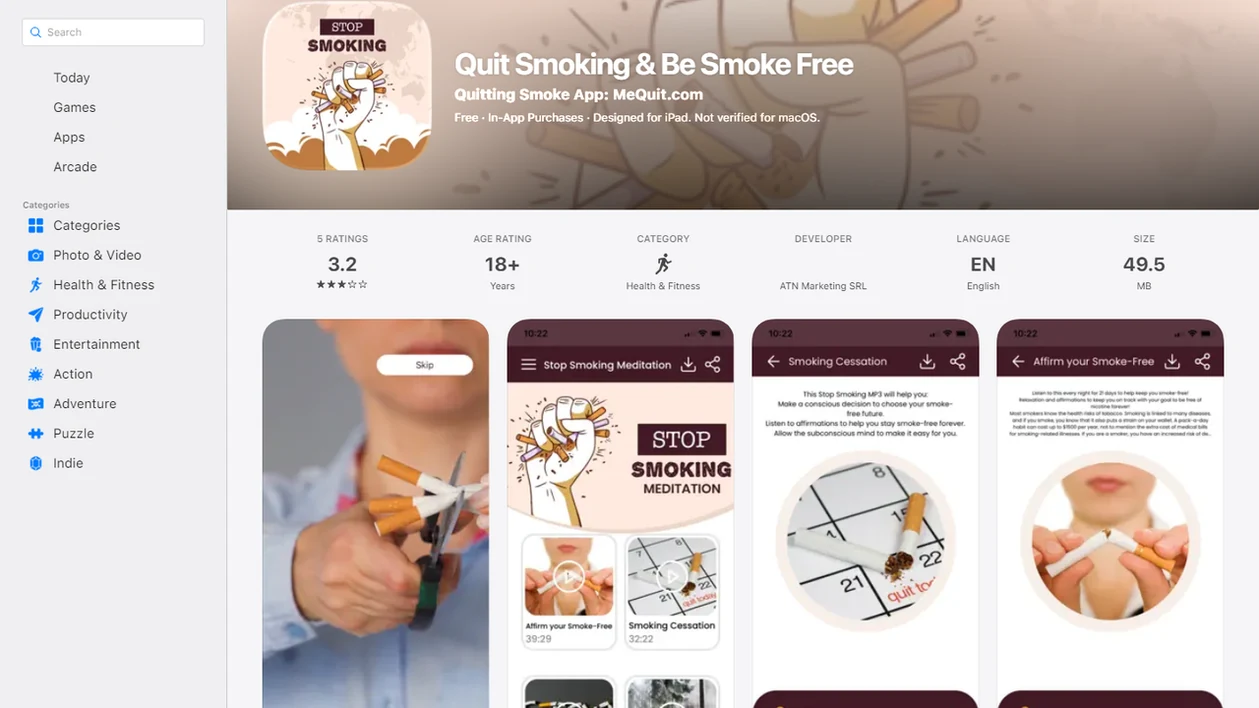
What An App To Help Me Stop Smoking Should Do Today
“I need an app to help me stop smoking today.” The app should help you make one clear quit plan, then support the next craving window with tools you can use before you smoke.
A useful stop smoking help app does six jobs: sets a quit date, logs cravings, records triggers, sends reminders, tracks progress, and helps you reset after a slip. That matters because quitting is usually not one clean attempt. Per the CDC, about 55% of U.S. adult smokers reported trying to quit in the past year, but only about 7.5% quit recently.
That gap is not a character problem.
It means support needs to be repeatable. If the first morning cigarette before coffee is your danger point, the app should be ready before your lighter is. For a broader comparison, our best quit smoking app guide explains which features matter most.
Stop Smoking Help App Features At A Glance
A stop smoking help app is most useful when it combines motivation with real coping tools. Badges can feel good, but they do not replace a plan for the three minutes when your chest tightens and your brain starts bargaining.
| Feature | What it does | Why it matters |
|---|---|---|
| Craving timer | Helps you delay smoking for 3 to 5 minutes | Cravings often pass when interrupted |
| Trigger log | Records time, place, mood, and cue | Shows patterns you can plan around |
| Custom reminders | Sends prompts before risky moments | Helps before autopilot takes over |
| Streak and money tracking | Counts smoke-free time and money saved | Makes progress visible |
| Health milestones | Shows likely body changes over time | Gives a reason to keep going |
| Relapse reset | Keeps learning after a slip | Reduces shame and all-or-nothing thinking |
| Multi-habit tracking | Tracks smoking, vaping, and alcohol | Spots linked routines |
Tools like MeQuit can be useful for smoking, vaping, and mindful alcohol reduction, not as a guaranteed clinical outcome, but as private day-by-day support.
How A Quit Smoking App Works Behind The Craving
A quit smoking app works by interrupting the habit loop: trigger, urge, action, reward, and reflection. In plain terms, it helps you notice what set off the craving before smoking becomes automatic.
The data flow is simple. You log cigarettes avoided, cravings, mood, time, place, and trigger. After a week, patterns start showing up. Maybe driving home is worse than lunch. Maybe Friday 6 p.m. drinks make cigarettes feel automatic. That is useful information, not a lecture.
The reminder system then acts like a timed interruption. A prompt before a work break can nudge you toward breathing, walking, texting someone, or delaying the cigarette. Clinicians typically recommend combining behavioral support with evidence-based quitting tools when dependence is higher. Apps can support behavioral counseling principles, but they do not replace medical care, medication advice, or a quitline.
For many adults, phone-based craving support is often easier than paper tracking because the tool is already in the pocket when the urge arrives.
Before You Start Using An App To Quit Smoking
Before you start using an app to quit smoking, decide what the app is helping you do in the next few days: stop completely or reduce in a planned way. A little setup now makes the first craving less chaotic.
- Choose your starting strategy by naming whether today is a quit day, a quit-date countdown, or the first day of cutting down. Avoid leaving that decision for the moment you want a cigarette.
- List your highest-risk cigarettes including the ones tied to waking, coffee, driving, meals, work breaks, alcohol, stress, or bedtime. Add the usual time and place if you know them.
- Check your support level if you smoke heavily, wake to smoke, have strong withdrawal, or have tried many times before. A quitline, clinician, pharmacist, or counselor can help you pair the app with stronger support.
- Review privacy settings before logging cravings on a shared phone or visible lock screen. Notifications can reveal more than you expect.
- Prepare one replacement action such as gum, water, a short walk, slow breathing, or texting someone before the first urge hits.
How To Use An App To Quit Cigarettes In Five Steps
Use an app to quit cigarettes by setting your plan before cravings become urgent. The first setup matters more than the download.
- Set a quit date for today, tomorrow, or a specific day this week, then choose whether you are quitting all at once or cutting down first.
- Add your cigarette baseline by logging how many you smoke, what they cost, and which cigarettes feel hardest to skip.
- Log your trigger times such as waking, driving, meals, work breaks, alcohol, stress, or the cold porch rail before sunrise.
- Use a craving plan with breathing, urge surfing, a short walk, water, gum, or a five-minute delay before deciding.
- Review daily check-ins to see cravings avoided, money saved, and health milestones.
- Reset after a slip by recording what happened and changing one reminder or trigger plan.
If you want a phone-first workflow, our guide on how to quit smoking with phone goes deeper.
Smoking Craving Help For Triggers, Stress, And Routines
Smoking craving help works best when it gives you a sequence to follow immediately: open the app, name the urge, log the trigger, start a five-minute exercise, and delay the cigarette. The order matters because cravings move fast.
- Cravings usually rise, peak, and pass more easily when you interrupt the routine early.
- Common triggers include coffee, driving, alcohol, stress, meals, work breaks, and social smoking.
- A craving log should capture mood and setting, not just whether you smoked.
- Useful coping tools include slow breathing, distraction, urge surfing, replacement routines, and reminder prompts.
- Delaying one cigarette is still useful data, even if the whole day was messy.
The pocket check is real.
Some people open the app during a three-minute craving instead of arguing with themselves for an hour. That small next step can protect the next hour, and sometimes the rest of the day.
Evidence For Stop Smoking Help App Support
The evidence is strongest for behavioral support plus approved cessation treatment, not for any app acting alone. A quit smoking app is best understood as digital behavioral support that can sit beside quitlines, counseling, nicotine replacement therapy, or prescription medication.
- Per the CDC, about 28.3 million U.S. adults, or 11.5% of adults, smoked cigarettes in 2021 (CDC: https://www.cdc.gov/tobacco/campaign/tips/resources/data/cigarette-smoking-in-united-states.html).
- Smoking causes more than 480,000 deaths each year in the United States, including secondhand smoke deaths (CDC: https://www.cdc.gov/tobacco/datastatistics/factsheets/healtheffects/tobaccorelated_mortality/index.htm).
- The 2020 HHS Surgeon General report found that behavioral counseling plus FDA-approved cessation medications can more than double quit success compared with minimal or no support (HHS: https://www.hhs.gov/sites/default/files/2020-cessation-sgr-full-report.pdf).
- An app can help by delivering prompts, craving logs, coping exercises, and progress feedback between formal support sessions.
- No app should claim it doubles quit success by itself unless that exact app has been tested that way.
The most common medically supported way to improve quit chances is behavioral support combined with FDA-approved cessation medication when appropriate.
Apps That Track Smoking, Vaping, And Drinking Triggers
Some adults need support for more than cigarettes because vaping, alcohol, stress, and social routines can all feed the same craving loop. A multi-habit tracker can help show when one behavior raises risk for another.
When smoking, vaping, and alcohol are tracked in one place, cross-habit triggers become easier to see. A pub exit through the smoking area may link drinking and cigarettes. A stressful commute may link vaping and later smoking. The point is not to label everything as one problem. It is to see the pattern clearly enough to change it.
Good multi-habit recovery tools deliver craving tracking, trigger insight, and reset planning, not medical detox or a promise that urges disappear.
Youth vaping data also matters as context. Per the CDC, about 10% of U.S. middle and high school students used a tobacco product in 2023, with e-cigarettes most common, but this page is focused on adults.
Common App To Quit Cigarettes Mistakes
The most common app to quit cigarettes mistakes happen when people download the tool but never turn it into a quit plan. The app needs to become part of the craving routine, not just an icon beside your weather app.
- No quit plan: Downloading an app without a date, baseline, or trigger list leaves you guessing during cravings.
- Badge-only tracking: Streaks and badges can motivate, but they are weaker without breathing tools, delay exercises, or coping prompts.
- Deleting after a slip: Erasing progress can increase shame and remove the data that explains what happened.
- Ignoring linked triggers: Alcohol, vaping, stress, sleep loss, and social smoking can all restart cigarette routines.
- Opening it too late: Use the app when the urge starts, not after shoes are on and you are walking to the store.
Reset the plan.
If health progress keeps you motivated, a quit smoking app with health milestones can make the invisible changes easier to notice.
Limitations
An app can support quitting, but it cannot quit for you or replace care when nicotine dependence is high. Some people need more than reminders, streaks, and craving logs.
- An app cannot replace medical care during pregnancy, serious withdrawal symptoms, high nicotine dependence, or co-occurring mental health concerns.
- Nicotine replacement therapy, prescription medications, quitlines, counseling, or professional support may be needed.
- Many quit smoking apps have limited clinical testing, so results vary by dependence level, consistency, and outside support.
For people comparing cost and access, a free quit smoking app may be enough to start, but support needs can change.
FAQ
Do quit smoking apps work?
Quit smoking apps can help with tracking, prompts, coping tools, and trigger awareness. They work best with consistent use and evidence-based support such as quitlines, counseling, or medication when appropriate.
What is the best quit smoking app for cravings?
The best quit smoking app for cravings depends on the quality of its craving tools, trigger tracking, reminders, privacy settings, and whether it also tracks vaping or drinking. Adults who also vape or drink may prefer an app that tracks those linked triggers in the same place.
Can an app stop cigarette cravings?
An app cannot remove cigarette cravings instantly. It can help you delay, manage, and learn from cravings so they are less likely to turn into smoking.
Should I set a quit date in a smoking app?
Setting a quit date helps many people prepare reminders, coping plans, and trigger alerts before the day arrives. If a fixed date feels too much, a short cut-down plan can still make the app useful.
What should I do if I smoke again after quitting?
Treat a slip as data, not failure. Log what happened, identify the trigger, and reset the plan without deleting your progress.
Can I track vaping and cigarettes in the same app?
Yes, some apps let you track vaping and cigarettes together. This can matter when someone replaces cigarettes with e-cigarettes but still has nicotine cravings and trigger patterns.
Do I need nicotine patches with a quit smoking app?
Some people benefit from nicotine replacement therapy such as patches, gum, or lozenges. Ask a clinician or pharmacist if you have high dependence, medical questions, pregnancy, or past withdrawal problems.
Are quit smoking apps private?
Quit smoking apps vary in privacy protections. Review privacy settings, data policies, account requirements, and notification visibility before using any app.