
Best Smoking Cessation Programs and Apps in 2026
A good program should help with the moments when smoking feels automatic: the 7 a.m. coffee cigarette, the drive home, a stressful call or Friday drinks. Some people need live coaching. Others want a private tracker, structured lessons, medication or several forms of support together.
This guide compares five iPhone apps plus quitline and clinician-supported programs. App Store prices, ratings and release information were checked in October 2026. A free download does not always mean every feature is free.
Quick answer
The strongest smoking cessation program combines practical behavioral support with quit-smoking medication when appropriate. For daily tracking, NicLess is our top app pick. For structured lessons, the MeQuit program ranks second. Free options include quitSTART and 1-800-QUIT-NOW. App ratings reflect user reviews, not proof that an app increases long-term quit rates.
Smoking cessation programs compared
The best format depends on the help you need most. Quitlines provide live coaching, clinical programs can include medication, and apps are useful for lessons, reminders, craving records and progress tracking between appointments.
| Program | Best for | Cost model | Human support | Main limit |
|---|---|---|---|---|
| 1-800-QUIT-NOW | Free coaching and quit planning | Free US quitline | Telephone coaching, with other services in some states | Services and free medication offers vary by state |
| Clinician-supported treatment | Counseling plus medication | Depends on insurance, provider and medication | Doctor, pharmacist, counselor or group | Requires access to care |
| NicLess | Tracking cigarettes, vapes or pouches | Free download | No | New app with no US ratings yet |
| MeQuit Quit Smoking program | A structured lesson course | Free download | No | About an hour a day and no cigarette tracker |
| Smoke Free | An established progress tracker | Free core tools, optional Pro plan | In-app support features | Pro price was not provided in the research notes |
| quitSTART | A free public-health app | Free | No live coach in the app | Less intensive than a coached program |
| QuitNow | Community alongside tracking | Free download | Peer community | Community support is not clinical counseling |
App Store stars show user satisfaction, not clinical effectiveness or verified quit rates.
How we ranked the smoking cessation apps
We ranked these apps by how well their listed features fit common quitting situations. Feature coverage and scenario fit carried more weight than popularity, which is why a new unrated app can place above an older app.
- Scenario fit, 35%: Help for cravings, tapering, slips, triggers and different nicotine products.
- Practical features, 25%: Tracking, lessons, reminders, planning and tools that can be opened during an urge.
- Cost clarity, 15%: Free access ranked well, while unclear upgrade pricing counted as a limit.
- Rating history, 15%: US App Store rating, review count and the difference between a new and established listing.
- Release and update history, 10%: Launch date and recent maintenance based on October 2026 store information.
NicLess and the MeQuit program are made by the team behind MeQuit, and readers who want a long rating history can start with the established apps listed below. We did not treat store descriptions or star ratings as evidence that an app causes people to quit.
The 5 best smoking cessation apps
NicLess ranks first for broad nicotine tracking, while the MeQuit program ranks second for people who want a lesson-based course. Smoke Free, quitSTART and QuitNow offer stronger rating histories or different forms of support.
1. NicLess: Best for cigarettes, vapes and pouches
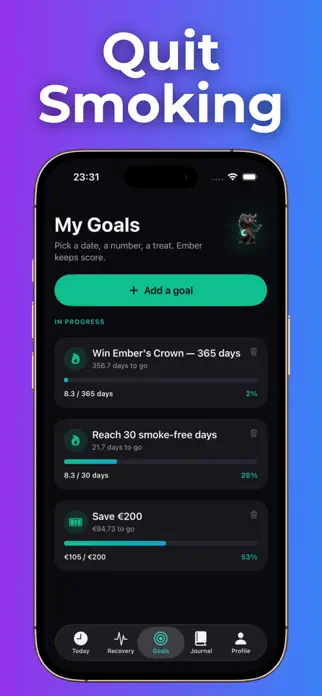
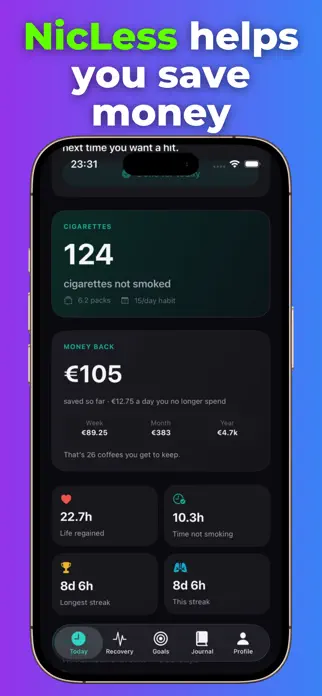
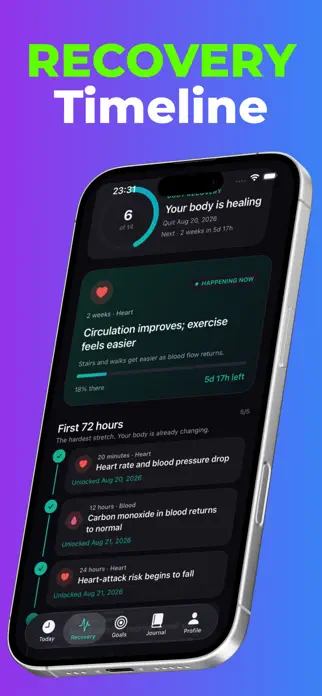
NicLess on the US App Store tracks a live nicotine-free streak, money saved and cigarettes, pods or pouches avoided. Its cut-down mode offers gentle, steady or fast pacing with a falling daily limit, followed by one tap to begin a quit streak. The craving button records intensity from 1 to 10, tags triggers such as coffee, stress or alcohol, and saves the entry in a journal.
- Key features: Cut-down plans, craving and trigger records, recovery timeline, five-day quests, mood check-ins, reminders and a no-lecture slip button.
- Cost: Free download. No subscription price was supplied in the store facts.
- Rating: No US ratings yet. It launched September 17, 2026.
- Honest limit: It is too new to have a meaningful rating or release history. Data stays on the iPhone and no account is required.
2. MeQuit Quit Smoking program: Best structured course
MeQuit Quit Smoking on the US App Store is a behavior-change course for smoking and vaping. It uses daily reading, videos, exercises, CBT concepts, cue exposure, conditioning ideas and hypnosis-style mental exercises. Users continue smoking during the course and choose a quit date when ready.
- Key features: Daily guided sessions, video, reading and exercises totaling about 8 to 10 hours.
- Cost: Free download. Subscription pricing was not included in the supplied store information.
- Rating: 3.2 stars from 5 US ratings.
- Honest limit: The rating sample is very small, sessions require about an hour a day, and the app does not track cigarettes.
3. Smoke Free: Best established progress tracker
Smoke Free on the US App Store shows time quit, money saved, cigarettes avoided and health milestones. It also includes craving notes, trigger mapping, goals and daily missions. Its long history makes it a reasonable starting point for someone who values a large volume of user feedback.
- Key features: Quit clock, health progress, craving patterns, savings goals and daily missions.
- Cost: Free download with free core tracking and an optional Pro level. The supplied facts do not list the Pro price.
- Rating: 4.8 stars from 57,273 US ratings.
- Honest limit: Some planned support is placed in Pro, and the exact upgrade cost is unclear here.
4. quitSTART: Best free government-backed app
quitSTART on the US App Store is made for Smokefree.gov by the National Cancer Institute in collaboration with the US government. It uses smoking-history information to provide tailored tips, challenges, badges and ideas for handling cravings or bad moods.
- Key features: Quit preparation, progress badges, games, challenges, a Quit Kit and help getting back on track after a slip.
- Cost: Free. No subscription is described in the supplied store information.
- Rating: 4.6 stars from 2,424 US ratings.
- Honest limit: It does not replace live counseling, medication advice or a personalized clinical plan.
5. QuitNow: Best for peer community
QuitNow on the US App Store combines a quit clock with community features. Its home screen shows time since the last cigarette, cigarettes avoided, money saved and estimated life regained. It has been available since 2011.
- Key features: Progress statistics, milestones and an ex-smoker community.
- Cost: Free download. The supplied facts do not state subscription prices or which upgrades may require payment.
- Rating: 4.7 stars from 13,601 US ratings.
- Honest limit: Peer conversation can provide encouragement, but it is not confidential clinical counseling or medication guidance.
Free quit smoking programs and quitline support
The main free smoking cessation hotline in the United States is 1-800-QUIT-NOW. It connects callers with their state quitline for coaching, a quit plan and information about local services.
US quitlines serve every state, Washington, DC, Guam and Puerto Rico. Depending on location and funding, services may include phone calls, text messages, chat, online tools or free nicotine patches, gum or lozenges for eligible adults. Availability and supply vary, so ask exactly what your state offers.
- Call 1-800-QUIT-NOW and describe how much you smoke, your first cigarette of the day and previous quit attempts.
- Ask what quitline coaching, text support and nicotine-replacement benefits are currently available.
- Choose a quit date or discuss a planned reduction if you are not ready to stop immediately.
- Write down predictable triggers, including coffee, driving, work breaks, stress and alcohol.
- Use an app between coaching calls to record urges, slips and questions for the next call.
Quitline coaching is best for live planning and accountability. An app is better for capturing an urge while it is fresh, such as reaching for the car vape or stepping outside after dinner. Both can fit into a broader quit-smoking plan.
How to choose a quit smoking program
Choose based on the problem that most often breaks your plan, not the longest feature list. Start with one primary source of support and add another tool only when it has a clear job.
| Your situation | Useful starting point |
|---|---|
| You want personal accountability | Quitline, counselor or clinician |
| You smoke, vape or use pouches | A multi-product tracker such as NicLess |
| You want daily lessons before quitting | A structured course such as the MeQuit program |
| You need a completely free app | quitSTART |
| You want a large rating history | Smoke Free or QuitNow |
| You are not ready to stop today | A time-limited gradual reduction plan leading to a quit date |
| Withdrawal repeatedly leads to smoking | A clinician or pharmacist plus appropriate smoking cessation aids |
Cutting down can prepare you to quit, but reduced smoking should not be treated as the final health goal.
How to put your program into action
A useful program turns general motivation into specific actions for your next coffee, commute, work break and social event. Set up the plan before the hardest craving arrives.
- Choose a quit date or a short reduction period that ends with one.
- Book a quitline call, clinician visit or counseling session.
- Ask a clinician or pharmacist about medication if withdrawal has been difficult before.
- Remove cigarettes, ashtrays and lighters before the quit date.
- Plan replacements for coffee, driving, meals, stress and time around other smokers.
- Put the quitline number and your craving tool where you can reach them quickly.
- If you smoke once, resume the plan immediately and review the trigger rather than abandoning the attempt.
A lapse is information, not proof that the program failed. Record the place, feeling and cue, then adjust the next response. Our guide to a smoking slip-up explains what to do that day.
Get prompt medical help for chest pain, trouble breathing, a severe allergic reaction, severe mood changes or suicidal thoughts. Contact a clinician or pharmacist before choosing medication if you are pregnant, breastfeeding, have kidney or heart disease, have a seizure history or take other medicines.
Where medication fits into smoking cessation
Medication can reduce nicotine withdrawal while counseling addresses routines, triggers and coping skills. The CDC says combining counseling and medication provides the best chance of quitting, yet only 5.3% of US adults who tried to quit in 2022 used both.
The CDC smoking cessation data also found that 38.3% used counseling or medication. The WHO tobacco cessation guideline recommends nicotine-replacement therapy, varenicline, bupropion and cytisine. Availability and approved uses differ by country. People in the United States should not assume cytisine is locally available or approved, and should ask a clinician or pharmacist.
A 2024 Cochrane evidence update found that these medication approaches help people quit. It also reported strong evidence favoring varenicline over bupropion or one form of nicotine replacement. Patch plus a fast-acting option, such as gum or a lozenge, can be more effective than one form of nicotine replacement alone.
Medication choice is individual. Review pregnancy or breastfeeding, kidney or cardiovascular disease, seizure history, mental health symptoms and current medicines with a clinician or pharmacist. See our overview of quit-smoking medication for questions to bring to that conversation.
Smoking cessation program FAQ
What is the most effective smoking cessation program?
Programs that combine behavioral counseling with an evidence-based medication generally offer the strongest chance of quitting. The right medication and counseling format depend on health history, smoking pattern, cost and access. An app can support the plan with reminders and trigger records, but it should not be assumed to replace treatment.
Are there free quit smoking programs?
Yes. Call 1-800-QUIT-NOW for free state quitline support. Services can include coaching, texts, chat and nicotine-replacement products for eligible callers, although benefits vary by state and funding. quitSTART is also a free public-health app with tailored tips, badges, games and craving support.
What does a quitline do?
A quitline coach can help identify triggers, choose a quit date, prepare for withdrawal and plan for slips. The coach may also explain medication options and local benefits. Some state quitlines offer text or online support and free nicotine patches, gum or lozenges to eligible adults.
Do smoking cessation apps work?
Apps can make a quit attempt more organized by tracking progress, recording triggers and putting coping prompts within reach. Results depend on the app, use pattern and other support. App Store stars measure user reviews, not verified abstinence. Consider pairing an app with counseling or medication when appropriate.
Can a smoking cessation program help me cut down first?
Yes. A planned reduction can help someone who is not ready to stop immediately. Use a falling daily limit and set a firm quit date rather than reducing indefinitely. Complete cessation remains the health goal because smoking fewer cigarettes still exposes the body to toxic combustion products.
How long does a quit smoking program take?
Program length varies. Some apps provide daily tools without an end date, while lesson courses may run for several days or weeks. Counseling and medication can continue longer based on need. Choose a program you can realistically use during high-risk situations, not simply the shortest option.
Does health insurance cover smoking cessation programs?
Coverage varies by insurer, plan, state and treatment. Ask about counseling visits, group programs, nicotine patches, gum, lozenges, varenicline and bupropion. A state quitline may offer free support or nicotine replacement even if insurance coverage is limited, but eligibility and supplies can change.
Sources and further reading
- Apple App Store: Quit Smoking Tracker - NicLess
- Apple App Store: Quit Smoking & Be Smoke Free
- Apple App Store: Smoke Free - Quit Smoking Now
- Apple App Store: quitSTART - Quit Smoking
- Apple App Store: QuitNow
- CDC: Smoking Cessation Data and Statistics
- World Health Organization: Clinical Treatment Guideline for Tobacco Cessation
- Cochrane: Pharmacological Treatments for Smoking Cessation