

8 Best Apps to Help You Quit Zyn and Nicotine Pouches
Quitting Zyn involves two problems: nicotine withdrawal and the repeated habit of reaching for a pouch during coffee, driving, work, or stress. A useful app should help with both. It should count pouches, reveal triggers, support a taper or quit date, and give you something specific to do when a craving hits.
We ranked eight apps using their US App Store information as of October 6, 2026. Most were built for smoking or vaping, not pouches. We identify that limitation clearly so you can avoid relying on cigarette health estimates that do not apply to exclusive pouch use.
Quick answer
NicLess is our top app to quit Zyn because it directly tracks nicotine pouches, supports gradual reduction, and records cravings and triggers. The MeQuit program ranks second for people who prefer structured daily lessons. No app has been established as a treatment specifically for quitting Zyn, so use one as a practical tracker and support tool.
Quick comparison of apps for quitting Zyn
NicLess has the closest direct fit because it lets you select and count nicotine pouches. The other apps can still provide taper plans, craving tools, lessons, timers, or accountability, but most use smoking-focused language.
| Rank and app | Best for | Platform | Cost model | US App Store rating |
|---|---|---|---|---|
| 1. NicLess | Direct pouch tracking and tapering | iPhone | Free download | No ratings yet |
| 2. MeQuit Quit Smoking program | Structured daily lessons | iPhone | Free download | 3.2 from 5 ratings |
| 3. Flamy | Gradual reduction and quit-date planning | iPhone listing reviewed, Android not confirmed | Free download, check store for current optional purchases | 4.9 from 57 ratings |
| 4. EasyQuit | A simple slow-mode schedule | iPhone listing reviewed, Android not confirmed | Free download, check store for current optional purchases | 4.7 from 1,149 ratings |
| 5. Smoke Free | Established craving and progress tools | iPhone and Android | Free core tools, optional paid upgrades | 4.8 from 57,273 ratings |
| 6. Kwit | CBT-style craving exercises | iPhone listing reviewed, Android not confirmed | Free download, check store for current optional purchases | 4.7 from 2,824 ratings |
| 7. QuitNow | Community accountability | iPhone and Android | Free basic tools, optional PRO plans | 4.7 from 13,601 ratings |
| 8. quitSTART | A fully free public-health app | iPhone listing reviewed, Android not confirmed | Free | 4.6 from 2,424 ratings |
NicLess and the MeQuit program are made by the team behind MeQuit. Readers who want a long rating history can start with the established apps listed below.
How we ranked these nicotine quitting apps
Pouch-specific usefulness received the most weight, followed by behavioral structure and tools for tapering or handling cravings. Ratings helped assess product maturity, but they were not treated as evidence that an app increases quit rates.
- 35%: direct usefulness for nicotine pouch users
- 20%: structured behavioral support
- 15%: tapering and immediate craving tools
- 10%: depth and history of App Store ratings
- 10%: platform availability
- 10%: evidence basis, transparency, and realistic claims
This is an editorial ranking of the supplied US App Store set, not a systematic audit of every nicotine app. We also considered how easily a smoking app could be adapted to pouch strength, pouch frequency, and cue-linked use. For broader comparisons, see our guide to apps for quitting smoking, vaping, and drinking.
Best apps that can support quitting nicotine pouches
The best choice depends on the support you need. NicLess is our editorial pick for direct pouch tracking, while the remaining apps are strongest for lessons, tapering, cravings, community, or an established rating history.
1. NicLess: Best for tracking pouches and cutting down
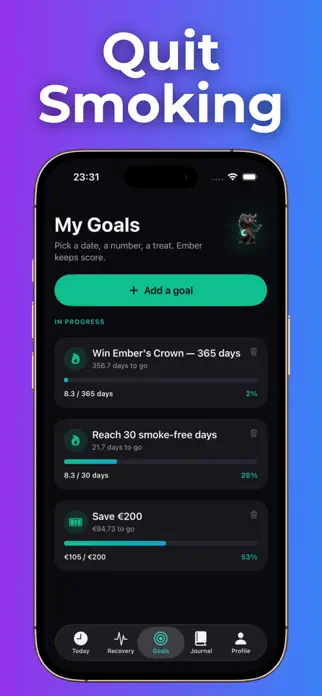
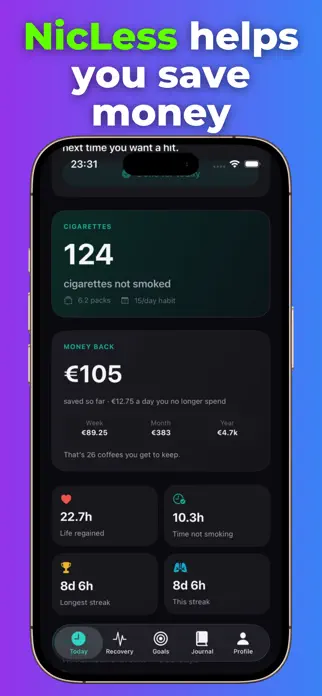
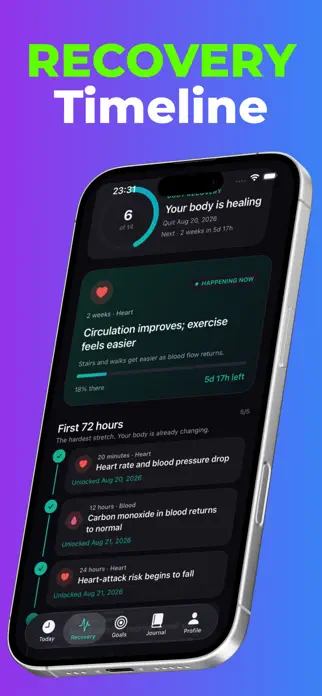
NicLess tracks cigarettes, vapes, and nicotine pouches in one app. Its cut-down mode offers gentle, steady, or fast pacing with a falling daily limit, followed by one-tap quit tracking. The craving button records intensity from 1 to 10, tags triggers, and guides breathing through the roughly three-minute craving peak. Data stays on the iPhone and no account is required. Cost: free download. Rating: none yet. Limit: it launched September 17, 2026, so it has no rating history or established outcome evidence.
2. MeQuit Quit Smoking program: Best for structured lessons
The MeQuit program offers daily reading, video, and exercises based on CBT, cue exposure, conditioning ideas, and hypnosis-style mental exercises. The full program takes about 8 to 10 hours, with sessions of about an hour a day. You continue using nicotine during the course and choose a quit date when ready. Cost: free download. Rating: 3.2 from 5 US ratings. Limit: it does not count pouches or cigarettes, and the very small rating sample gives little information about broad satisfaction.
3. Flamy: Best for a planned taper and quit date
Flamy offers a personalized reduction plan, a set quit date, craving and slip logs, savings goals, breathing exercises, and nicotine-replacement tracking. Those features can be adapted by treating each pouch as one tracked unit. Cost: free download, with current optional purchase pricing best checked in the store. Rating: 4.9 from 57 ratings. Limit: it is designed around smoking and vaping, so pouch users must reinterpret cigarette counts and health milestones.
4. EasyQuit: Best for a straightforward slow mode
EasyQuit includes a customized slow mode, money statistics, a diary, badges, and health countdowns. It may suit someone who mainly wants a declining daily limit without a large lesson program. Cost: free download, with any current optional purchase pricing listed in the store. Rating: 4.7 from 1,149 ratings. Limit: its plan and health displays are cigarette-focused and do not account for pouch strength.
5. Smoke Free: Best for established craving tools
Smoke Free provides a quit timer, money tracking, craving logs, notes, graphs, missions, and more than 40 behavior-change techniques. Its large rating history makes it a more established option, and it is available for iPhone and Android. Cost: free core tools with optional paid upgrades. Rating: 4.8 from 57,273 ratings. Limit: carbon monoxide and lung-recovery milestones do not map directly to exclusive Zyn use. Read our full Smoke Free app review.
6. Kwit: Best for CBT-style craving exercises
Kwit combines progress statistics with guided breathing, mini-games, motivation cards, and cognitive behavioral therapy techniques. These tools can provide a replacement action during the drive home or after-meal pouch craving. Cost: free download, with current optional purchase pricing best checked in the store. Rating: 4.7 from 2,824 ratings. Limit: its tracking centers on cigarettes rather than pouch dose or strength. See our detailed Kwit review.
7. QuitNow: Best for community accountability
QuitNow includes a quit timer, money and health statistics, achievements, craving support, and a community feature. It is available for iPhone and Android. Cost: basic functions are free, with optional QuitNow PRO plans whose current prices should be checked in the store. Rating: 4.7 from 13,601 ratings. Limit: community discussions may include inaccurate advice or content that brings up cravings. Its App Store listing remains smoking-focused.
8. quitSTART: Best for free tips and distractions
quitSTART was created by Smokefree.gov and the National Cancer Institute. It provides tailored tips, craving distractions, games, challenges, badges, a Quit Kit, and support after a slip. Cost: free. Rating: 4.6 from 2,424 ratings. Limit: it was built for cigarette smoking and does not directly track pouch use, strength, or daily nicotine exposure. Our quitSTART review covers its tools in more detail.
How to choose an app to quit Zyn
Choose around your hardest quitting problem, not the app with the highest star rating. A 4.9 rating may reflect usability and satisfaction, but it does not prove higher nicotine abstinence rates.
- Frequent, automatic pouch use: choose direct pouch counting and trigger tags.
- Not ready to stop at once: choose a taper with a falling daily limit.
- Strong cravings at predictable times: choose breathing, distraction, or craving-journal tools.
- You prefer a course: choose structured lessons instead of a basic streak counter.
- Accountability helps: consider community or buddy tools, but confirm medical claims elsewhere.
- Privacy matters: check account requirements, data storage, and deletion controls before entering health information.
Do not choose by cigarette health milestones. For exclusive pouch use, prioritize daily pouch count, strength, trigger, time, money, and days nicotine-free.
Contact a clinician or pharmacist if withdrawal feels unmanageable, you repeatedly return to heavy pouch use, or you need help selecting nicotine-replacement or prescription treatment. Seek urgent help for chest pain, severe confusion, thoughts of self-harm, or signs of nicotine poisoning such as repeated vomiting, marked dizziness, or trouble breathing.
Set up a nicotine pouch tracker that is actually useful
Track the dosing habit before trying to change it. For several ordinary days, record each pouch when you use it rather than reconstructing the day from memory.
- Record the time, pouch strength, and situation for every pouch.
- Tag the cue, such as coffee, driving, after food, stress, boredom, alcohol, or seeing someone else use nicotine.
- Choose a quit date or set a scheduled reduction in the number of pouches.
- Plan one replacement for each major cue, such as sugar-free gum, a short walk, water, or paced breathing.
- Keep the app visible during the first 72 hours after stopping, when withdrawal commonly peaks.
- If you use a pouch after quitting, log the slip and restart the plan without treating it as a complete failure.
Our full plan for quitting nicotine pouches explains how to build a taper, prepare for triggers, and handle slips.
Can an app help you quit Zyn?
An app can support planning, awareness, and craving management, but research has not established that any app improves abstinence specifically for Zyn or other nicotine pouches. Most available evidence concerns cigarette smoking.
A review summarized in a 2023 digital cessation framework found no clear overall smoking-cessation advantage for smartphone apps alone: risk ratio 1.00, with a 95% confidence interval from 0.66 to 1.52, across 5 studies and 3,079 participants. A separate review of 9 randomized trials found no clear benefit from smartphone interventions alone, but reported better efficacy when digital support was combined with pharmacotherapy.
Medication evidence largely comes from smoking cessation, not exclusive pouch use. The CDC says nicotine-replacement therapy is generally used for 8 to 12 weeks and should not be stopped prematurely. Ask a clinician or pharmacist how that guidance applies to your pouch strength and daily use before choosing a dose. See the CDC guidance on quit medications.
What to expect after stopping nicotine pouches
Nicotine withdrawal commonly reaches its strongest point after 2 to 3 days, although cravings and mood changes can last longer. An app is most useful when it helps you respond to symptoms rather than only displaying a streak.
- Strong cravings
- Irritability or restlessness
- Trouble concentrating
- Sleep disturbance
- Headache
- Increased appetite
- Low mood
The clinical overview of nicotine withdrawal also reports that nicotine-replacement therapy increases smoking quit success by roughly 50% to 70% compared with unaided attempts. That estimate should not be presented as a Zyn-specific result.
Apps for quitting Zyn FAQ
Is there an app made specifically for quitting Zyn?
NicLess directly supports nicotine pouch tracking, but no app has been established through clinical trials as a treatment specifically for Zyn dependence. Several other apps can be adapted for pouches by treating each pouch as a tracked unit and recording strength, time, trigger, and craving intensity.
Should I taper Zyn or quit all at once?
Both approaches are used. A taper may feel more manageable if you use pouches frequently throughout the day, but it needs firm daily limits and an end date. Stopping at once is simpler but may produce stronger early withdrawal. A clinician or pharmacist can help if your nicotine intake is high.
What should a nicotine pouch tracker record?
Record the number of pouches, strength, time used, craving intensity, and trigger. Useful trigger categories include coffee, driving, work stress, after meals, alcohol, boredom, and seeing someone use nicotine. These details show which situations need a planned substitute rather than relying only on a daily total.
Can a quit-smoking app be used for Zyn?
Yes, if the app lets you reinterpret cigarettes as pouches or use its craving, diary, lesson, and savings tools independently. Ignore carbon monoxide, lung recovery, and cigarettes-avoided estimates if you only use pouches. Those displays are based on stopping combustible tobacco, not oral nicotine use.
How long does Zyn withdrawal last?
Nicotine withdrawal commonly peaks around 2 to 3 days after stopping. Irritability, concentration problems, sleep changes, appetite changes, and cravings may continue beyond that period. The timing varies with pouch strength, frequency, dependence, and other nicotine use.
Can I use nicotine gum or patches to quit Zyn?
Nicotine-replacement products may help manage withdrawal, but standard dosing guidance was developed mainly for cigarette smokers. Pouch strengths and patterns vary, so ask a clinician or pharmacist to help match the product and dose to your nicotine use, medical history, and other medications.