
U.S. Standard Drink Calculator
Quick answer
Enter the serving volume and alcohol by volume, or ABV, to estimate how many U.S. standard drinks it contains. One U.S. standard drink has 0.6 fluid ounces, or 14 grams, of pure alcohol. A large pour, strong beer, or cocktail with multiple shots may contain two or more standard drinks.
This free drink calculator works for beer, wine, spirits, canned cocktails, and mixed drinks when you know the total serving size and ABV. It accepts fluid ounces or milliliters and rounds the result to the nearest tenth. Use the number to compare servings or build a time-stamped alcohol log, not to decide when you are safe to drive or whether stopping alcohol suddenly is medically safe.
How do I read the calculator result?
The result is the estimated number of U.S. standard drinks in the full serving you entered. A result of 1.9 means the serving contains about 1.9 times the pure alcohol in one standard drink, even if it came in one glass or can.
- 1.0 means approximately one U.S. standard drink.
- 0.5 means approximately half a standard drink.
- 2.0 means approximately two standard drinks.
- The result describes alcohol content, not the number of containers.
For example, drinking one 16-ounce craft beer that produces a result of 1.9 should be logged as 1.9 standard drinks, not one drink. The CDC standard drink guide explains why stronger and larger servings count as more.
What formula does the standard drink calculator use?
The calculator divides the amount of pure alcohol in a serving by 0.6 fluid ounces, the U.S. standard-drink amount. It uses serving volume and ABV, not the drink name.
Fluid ounces: standard drinks = serving ounces × ABV percentage ÷ 60.
ABV means alcohol by volume. In the formula above, enter 5% as 5, not 0.05. The equivalent formula using a decimal is serving ounces × 0.05 ÷ 0.6. For metric amounts, the calculator first converts milliliters to fluid ounces using 1 fluid ounce as approximately 29.57 milliliters.
The U.S. definition is 0.6 fluid ounces, or 14 grams, of pure alcohol. Other countries use different definitions, so this is not the same as every international alcohol unit calculator.
What counts as one U.S. standard drink?
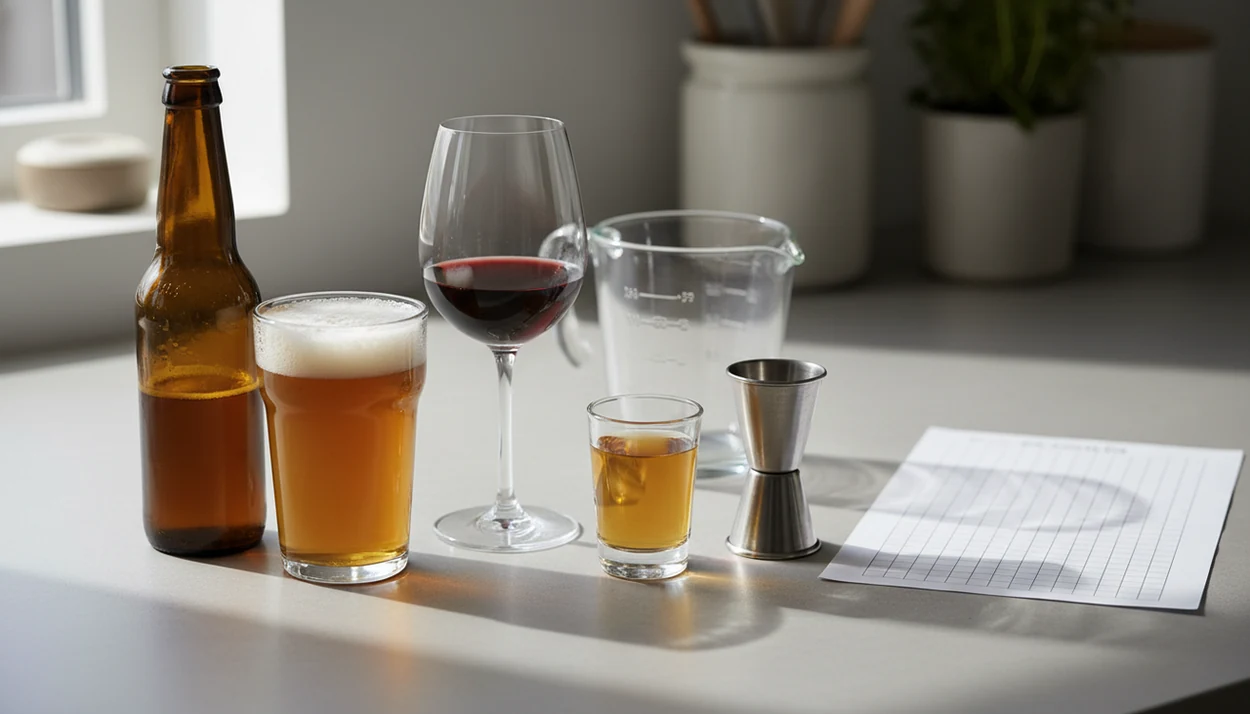
About 12 fluid ounces of 5% beer, 5 fluid ounces of 12% wine, or 1.5 fluid ounces of 40% spirits each contains approximately one U.S. standard drink. Actual servings often differ from these reference sizes.
| Drink | Serving | ABV | Approximate standard drinks |
|---|---|---|---|
| Regular beer | 12 fl oz | 5% | 1.0 |
| Craft beer | 16 fl oz | 7% | 1.9 |
| Wine | 5 fl oz | 12% | 1.0 |
| Large wine pour | 8 fl oz | 14% | 1.9 |
| Spirits | 1.5 fl oz | 40% | 1.0 |
| Mixed drink with 3 fl oz of spirits | 3 fl oz of 40% liquor | 40% | 2.0 |
A glass is not a fixed measure. A tall wine glass, a strong pint, or a cocktail containing several shots can hold two or more standard drinks.
How are standard drinks calculated in real examples?
Multiply the full serving volume by its ABV percentage, then divide by 60. For milliliters, convert the volume to fluid ounces first.
A 16-ounce craft beer at 8% ABV
16 × 8 ÷ 60 = 2.13. Rounded to the nearest tenth, the can contains about 2.1 U.S. standard drinks.
A 750 mL wine bottle at 12% ABV
750 ÷ 29.57 = about 25.4 fluid ounces. Then 25.4 × 12 ÷ 60 = 5.08. The bottle contains about 5.1 U.S. standard drinks.
A cocktail with two 1.5-ounce shots
Two shots equal 3 fluid ounces of spirits. At 40% ABV, 3 × 40 ÷ 60 = 2.0 standard drinks. Mixer volume does not add alcohol, but liqueurs, wine, or additional spirits do.
How do I track standard drinks accurately?
Record the container or pour size, ABV, calculated standard drinks, and time while the details are fresh. Count measured pours rather than assuming every glass contains one drink.
- Check the can, bottle, menu, or recipe for the ABV.
- Measure the serving with a jigger, marked glass, or container label when possible.
- Calculate and record the amount before drinking, rather than reconstructing the night later.
- Log the start and finish time, plus the setting, such as Friday work drinks or wine with dinner.
- Record alcohol-free intervals and any shaking, sweating, nausea, anxiety, or racing heartbeat between drinks.
This is how to use a standard drink tracker to calculate and log alcohol intake accurately. A time-stamped log can show that the 6 p.m. drink stayed near one standard drink on Tuesday, while strong game-night cans added up differently. It gives you a concrete pattern to review without treating the log like a judgment.
What can this alcohol calculator not tell me?
A standard-drink count estimates alcohol content only. It cannot measure blood alcohol concentration, diagnose alcohol dependence, predict withdrawal severity, or tell you when it is safe to drive.
- Alcohol effects vary with drinking speed, food, body size, medications, liver function, and other factors.
- Coffee, showers, exercise, and sleep do not make a calculator suitable for deciding when to drive.
- Cocktail estimates may be low if the recipe, pour size, or ABV is incomplete.
- Withdrawal can still occur after a substantial reduction, not only after completely stopping.
For someone who drinks heavily or regularly, symptoms may begin 6 to 12 hours after the last drink and are often most intense during the first 24 to 48 hours. Read about alcohol withdrawal symptoms and the typical withdrawal timeline. The NHS alcohol dependence guidance also explains when professional support is needed.
Get medical advice before stopping suddenly if you drink heavily every day, drink in the morning, have withdrawal symptoms between drinks, or have had a withdrawal seizure or delirium. Call emergency services for a seizure, hallucinations, confusion, severe agitation, or severe vomiting.
How can I use the result to drink less?
Use the result to set a specific limit, measure servings, and compare your planned amount with what you actually drank. Do not treat public-health limits as targets or as proof that drinking is safe for you.
The CDC describes moderate drinking as typically no more than one drink for women or two drinks for men on days when alcohol is consumed. Its binge-drinking threshold is four or more drinks for women or five or more for men on one occasion. See the CDC guidance on moderate alcohol use and alcohol-use definitions.
- Choose the number of standard drinks before the first pour.
- Buy only the amount planned and include alcohol-free days.
- Use lower-ABV drinks or smaller measured servings.
- Review totals by occasion and week, not just by container.
- If drinking has become difficult to control, discuss it with a clinician.
Our practical alcohol reduction plan provides more structure. If your goal is to stop, start with safe steps for quitting alcohol. Heavy daily drinkers should not stop suddenly without medical advice because withdrawal can be dangerous.
Standard Drink Calculator FAQ
How many standard drinks are in a bottle of wine?
A 750 mL bottle of wine at 12% ABV contains about 5.1 U.S. standard drinks. Bottle size and ABV can vary, so enter the numbers from the label for a closer estimate. A 750 mL bottle with a higher ABV will contain more standard drinks.
How many standard drinks are in a pint of beer?
A 16-fluid-ounce U.S. pint at 5% ABV contains about 1.3 standard drinks. At 7% ABV, it contains about 1.9. Check both the serving volume and ABV because a pint of strong craft beer may contain nearly twice the alcohol in a 12-ounce, 5% beer.
Does one glass of wine equal one standard drink?
Only when the glass contains about 5 fluid ounces of wine at 12% ABV. An 8-ounce pour at 14% ABV contains about 1.9 standard drinks. Home pours and restaurant glasses vary, so measuring the volume produces a better estimate than counting glasses.
How many standard drinks are in a shot?
A 1.5-fluid-ounce shot of 40% spirits is approximately one U.S. standard drink. A larger shot or higher-proof spirit contains more. If a cocktail has two standard 1.5-ounce shots of 40% liquor, the liquor alone contributes about two standard drinks.
Is a U.S. standard drink the same as an alcohol unit?
No. A U.S. standard drink contains 0.6 fluid ounces, or 14 grams, of pure alcohol. The term alcohol unit can use a different amount in other countries. Check which national definition a calculator follows before comparing results or copying numbers into a log.
Can a drink calculator tell me when I can drive?
No. This calculator estimates pure alcohol in a serving, not your blood alcohol concentration or driving fitness. Absorption and elimination vary between people and situations. Do not use a standard-drink total, elapsed time, coffee, food, sleep, or a shower to decide that driving is safe.
Can I use standard drinks to taper off alcohol safely?
A standard-drink log may help a clinician understand your intake, but the calculator is not a withdrawal treatment plan. Heavy daily use, morning drinking, symptoms between drinks, or previous withdrawal seizures require medical advice before a major reduction. NHS guidance on alcohol treatment and withdrawal support describes supervised options.